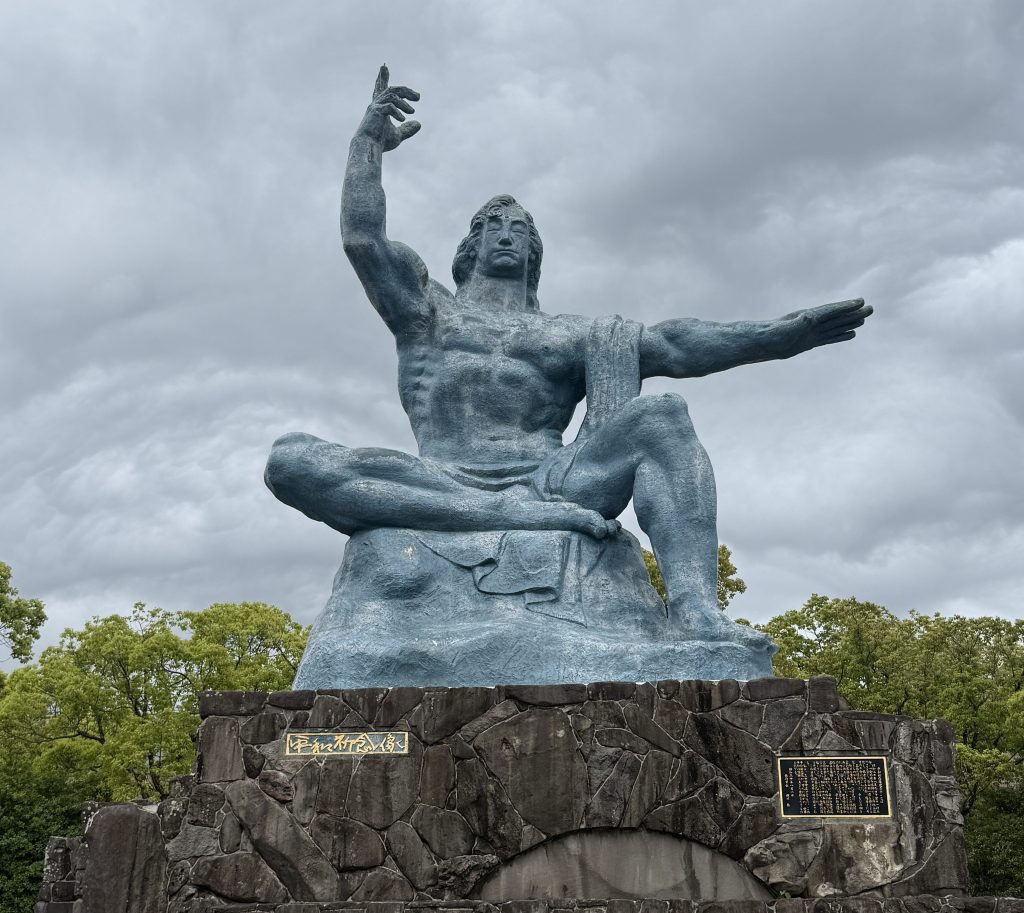
Dear Nagasaki,
I recently visited you with my husband, after our own busy season of celebrations: our wedding, and family from abroad coming to Japan to spend time with us. It was the first time our family members had connected in person — a big, peaceful gathering of Black family, coming together in laughter in our little corner of Yokohama. After all that joy and togetherness finally settled, we had time to come to you.
We visited Hiroshima three years ago. My mom used to tell me that seeing the Peace Memorial Park would bring me to tears. But when I stood there, what I actually felt was a large portion of disappointment, perhaps even anger. I was angry at my Japanese ancestors for possibly being so blind to the consequences of war. Angry at how fascism in Japan had literally torn families apart. Or perhaps my anger reached further, toward the superpower America that made the decision to use its most devastating weapon on the city, as if civilian lives did not matter regardless of how the war was going. It’s the same feeling I’ve carried over the years, watching the TV programs that cover the atomic bomb history every anniversary, sitting in a college political science class about Japan. The bombing was framed as something that is not supposed to happen at all, yet it unfortunately did, only in Japan so far, and it must stop there. No other country should experience what we experienced. Anger felt like the right emotion to carry, so that my generation and onward can make sure the world never makes the same mistake again.
But when I came to you, my reaction was completely different. I was so emotional inside—not simply the sadness my mom warned me about, but something deeper. This time, I was aware of another history that you carry. I knew about the Hidden Christians, the community that survived centuries of persecution, preserving their faith in absolute secrecy. I knew that they had finally, after so much suffering, built their dream: a great cathedral, only to have it destroyed in a single morning by a bomb dropped from a Christian-manned plane. And beyond that wound, I see that you are proud of a different resilient past: of keeping ties with the world, of keeping trade alive through every restriction. I learned so much about these details in depth during my visit.
And the people—wow. People were so warm, with such high energy. We met a taxi driver who was more than willing to take us around, becoming our impromptu tour guide. We didn’t spend too long with him, but the least we could do was offer a tip, something we know isn’t customary in Japan. Still, I felt we needed to show our appreciation in action. He had given us his time, his knowledge, and a piece of his city’s story without expecting anything back. That is what motivated me to show, by action, that I feel for what happened to you, by writing this letter.
I want you to know that I saw your beauty too. I looked out over your hills and harbors. I watched the sunset spread over your port. I traced your winding stone steps with my eyes and saw the evening lights begin to shimmer on the water. From that quiet height, I understood that you are not just a site of tragedy. You are a living city.
I see your international spirit, ancient and intentional. For over two centuries of isolation, you were the sole window to the world—the only port open to Dutch and Chinese traders. Dejima was your small but fiercely protected gateway. That cosmopolitan DNA is in your character. You have always looked outward and built bridges. You were Japan’s first truly international city, long before the bomb fell.
I also see that the Hidden Christians’ story did not end in ruin. The cathedral was destroyed, but the faith was not. The community survived. They still gather. Their descendants still pray. What you carry is not just loss. It is an unbroken continuity, a quiet triumph. The bomb could shatter stone and glass. It could not shatter a spirit that had already endured two centuries underground.
And I am learning that your voice is different from Hiroshima’s. Hiroshima carries a righteous anger that the world must hear. Your voice is more nuanced, more spiritual. Some of your survivors spoke of the bombing as a sacrifice, an offering—not to justify it, but to search for meaning in unbearable suffering. Your prayer seems not just for nuclear abolition. You whisper something deeper. You want the world to learn compassion, not just disarmament. You want a conversion of the human heart.
So I want to make you a small promise. I will not let you become only a tragedy in my mind. When I remember you, I will see the sunset over your port first. I will see the Hidden Christians and their broken cathedral that still gathers prayers. I will tell your name to people who have never heard it spoken with love.
 The Conscious Bridge
Leave a Comment