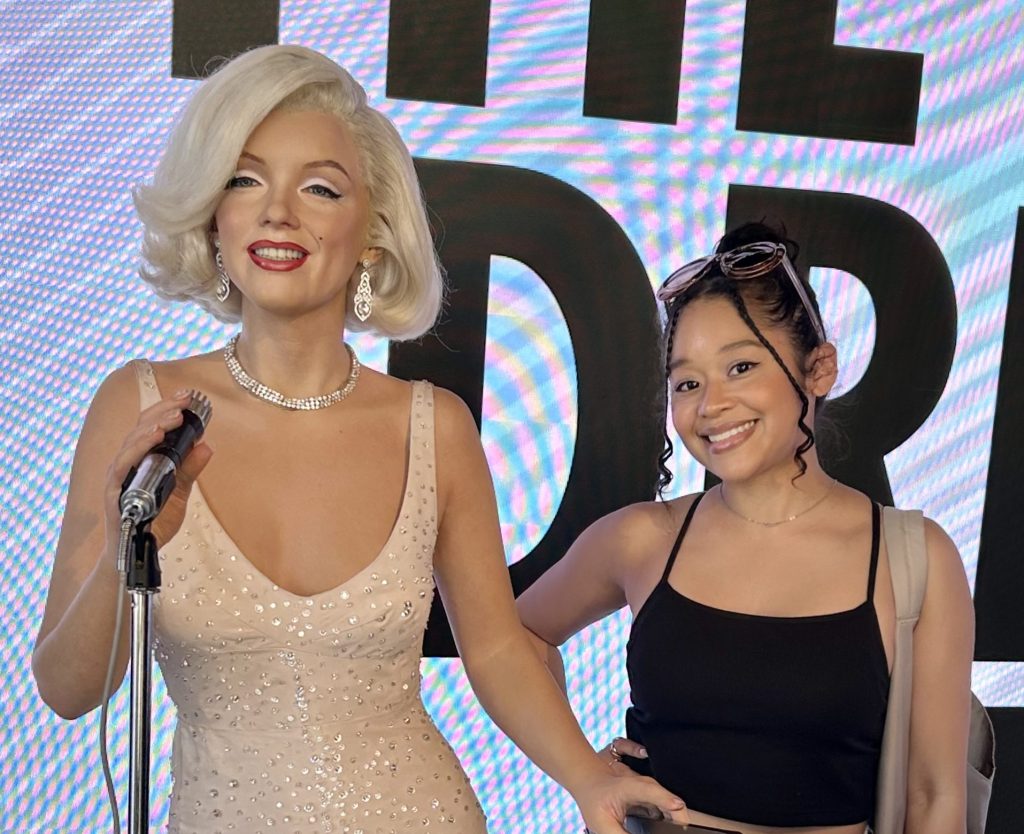
I could list the things I stand for, the music I love, or my opinions on the world, but every aspect of my identity is filtered through one undeniable lens: I am a woman. This reality shapes my experience in a society that remains problematic in its treatment of women. A pervasive issue I have personally navigated is the cycle of beauty trends engineered by capitalism and epitomized by Hollywood—a cycle where just as I believe progress is being made, a new, impossible standard emerges.
My own entanglement began in boarding school in Malawi. We were preparing for a Valentine’s Dinner, a student-run charity event where the auditorium was transformed into a candlelit venue. Eager for the night, I asked a senior girl known for her makeup skills to “do my face.” When I looked in the mirror, I was stunned. I looked so much better—or so I thought. I had aged three years in minutes. From that day on, eyeliner became a non-negotiable part of my routine; it made my eyes pop and, more importantly, made me feel confident. How did I measure that confidence? Quite simply: by the validation I received from others.
But the reality is far more complex. Society rarely grants women true respect for the labor of their appearance, even when they master it perfectly. We see women turn to cosmetic enhancements, yet the promised rewards—respect, commitment, validation—often remain out of reach. My own insecurities were perpetually sparked by the fluctuating nature of male attention: discovering I wasn’t a guy’s “type,” or the particular sting of comparing myself to his exes. As heterosexual women, especially those of us raised under capitalism and its media gaze, we’re taught to compete for the same narrow version of desirability. It’s a quiet, constant battle to be chosen.
For a long time, this was how I navigated the world. Had I not found a stable relationship after significant inner healing, I might still believe I needed to keep up with trends just to be worthy of love.
This points to the larger problem: these standards are a product of the patriarchy, designed for the male gaze. While biology plays a role in attraction, this dynamic has been distorted into a brutal form of consumerism, where women are presented as products to be browsed and “purchased”, with demand shaped by surface-level traits. I may have benefited, as my racially ambiguous features drew a certain kind of attention. But “being purchased” often isn’t a happy ending. It leads to what I call “illusion of attraction,” the ability to draw interest but not commitment. The focus on achieving marriage by polishing ourselves to a universal beauty standard is deeply detrimental to feminism. True empowerment cannot be found in being “unapologetically sexy” for a market that does not respect us.
This system oppresses all women, but it’s especially brutal toward darker-skinned women. They’re forced to navigate these hierarchies consciously and build their own forms of authenticity. Ironically, those very survival strategies are often co-opted, stripped of meaning, and repackaged as trends. That’s the cruelest part of the system: it creates our insecurities, sells us the solutions, and then turns us against each other when solidarity could be our greatest strength.
My understanding of this dynamic is personal, rooted in my first fractured encounter with womanhood. I admit that I did not have a healthy example in my earliest years. My birth mother, overwhelmed by what I now recognize as her own unmanaged anger, sadness, and frustration, harmed me physically. Although I was thankfully separated from her at age five, those critical formative years were marked by a lack of safety. The hurt of that child abuse remains. Now, when I feel a surge of rage that makes my body shake, my last thought is of her. I wonder what drove her to hurt her own child, and I fear I have inherited that rage. It is hard to know what parts of me come from her, as her existence became a taboo subject in our family, with my dad also a survivor of her violence.
Yet it was through other women that I found my path to healing and redefined strength. I was later blessed with a much kinder mom who cared for my childhood wounds, and I was surrounded by many more mother figures from my family in Malawi. From them, I learned love and compassion. Knowing that these resilient women are my blood gives me peace. Their love reminded me that a woman’s value isn’t a product to be consumed, but a force that heals and sustains.
It was these women—Black women—who reshaped me. They showed me that real power isn’t found in a makeup mirror, but in the mirrors they held up for me. Those mirrors didn’t reflect a trend or a product, but a person worthy of love, with or without eyeliner. My healing was a gift from them, a testament to the strength I witnessed and grew from.
That strength is what compels me to say: No woman, no cry. I see your beauty—a beauty forged in resilience, not in trend. You are the mirrors of true strength, and you deserve a world that sees you not as it does, but as you are: magnificent.


Leave a Comment